Mugwort (Artemisia vulgaris) grows at the intersection of earth wisdom and mystical practice, a silvery-green ally that ancient herbalists, medieval healers, and modern dreamworkers have all turned to when seeking clearer visions, deeper intuition, and protection through life’s threshold moments. The dream journeys described in old European and Asian texts were not produced by tired, depleted plants. They came from Mugwort that grew in vital, living ground.
To recreate the potency described in ancient texts, we can’t rely on sterile commodity soil. At Sacred Plant Co, our approach is rooted in regenerative thinking, because the vitality of the soil directly shapes the aromatic compounds and energetic presence of plants like Mugwort. This is the heart of restoring the lost intelligence of the plant: rebuilding the microbial life that lets an herb express its full chemistry. You can review the measurements behind this approach on our See the Science page.
Across the regeneratively grown herbs we work with, we have seen how soil health translates directly to plant medicine. When Mugwort is grown in living, biologically rich soil, it tends to develop more complex volatile oil profiles, a stronger aromatic presence, and what traditional herbalists might describe as enhanced spiritual resonance. This connection between regenerative cultivation and plant potency isn’t mysticism, it is biochemistry meeting ecology. The same soil microbiomes that help Mugwort produce its characteristic compounds of camphor, 1,8-cineole, and thujone are exactly what living-soil cultivation nurtures through composting, fermentation, and minimal disturbance. Whether you are new to spiritual herbalism or have practiced dreamwork for years, understanding how your Mugwort was grown matters for both practical results and ethical alignment with plant traditions.
KEY TAKEAWAYS
• Mugwort (Artemisia vulgaris) is an aromatic perennial in the Asteraceae family traditionally used for dream enhancement, intuitive development, and ritual cleansing, valued for volatile oils including thujone, camphor, and 1,8-cineole.
• Mugwort essential oil content ranges from 0.1% to 1.4% depending on harvest timing and growing conditions, with thujone acting as a GABA receptor modulator that may influence dream vividness during REM sleep.
• A standard dream tea uses 1 teaspoon of dried Mugwort per 8 ounces of water, steeped 5 to 7 minutes, taken 30 to 60 minutes before bed.
• Mugwort is most effective used cyclically, around 3 to 4 nights per week, which helps prevent tolerance while preserving its effect on dream recall.
• Mugwort is contraindicated in pregnancy and nursing because of its traditional use as an emmenagogue, and it should be avoided by people with Asteraceae allergies or seizure disorders.
• Properly stored in an airtight container away from heat and light, dried Mugwort holds its aromatic potency for roughly 12 to 24 months.
THE HISTORICAL THREAD: MUGWORT ACROSS CULTURES AND CENTURIES
EUROPEAN FOLK TRADITIONS
In Celtic Europe, Druids recognized Mugwort as one of their nine sacred herbs, employing it in divination rituals and as protection for travelers journeying between the physical and spirit worlds. Medieval herbalists called it “Mater Herbarum,” Mother of Herbs, acknowledging both its versatility and its special role in accessing non-ordinary states of consciousness. Travelers would place Mugwort in their shoes before long journeys, not merely for physical stamina but for spiritual protection, believing the herb created an invisible boundary against malevolent forces and ensured safe return home.
The association between Mugwort and the goddess Artemis (Diana in Roman tradition) established the plant’s connection to lunar cycles, women’s mysteries, and the hunt, both the literal pursuit of game and the spiritual hunt for wisdom through dreamtime. Medieval grimoires prescribed Mugwort for “seeing clearly in darkness,” a phrase that likely referred to both physical night vision and the metaphorical darkness of the unconscious mind. Dream pillows stuffed with Mugwort became common in folk practice, particularly on midsummer eve when the veil between worlds was considered thinnest.
ASIAN MEDICINE AND MOXIBUSTION
Traditional Chinese Medicine incorporated Mugwort (known as Ai Ye) into its energetic framework, understanding the plant as warm in nature and capable of moving stagnant Qi while driving out cold and dampness. The practice of moxibustion, burning dried Mugwort near acupuncture points, demonstrates ancient Chinese recognition of the herb’s ability to influence energy flow and consciousness. While Western spiritual practitioners focus primarily on Mugwort’s dream-enhancing properties, Chinese medicine emphasizes how the herb warms the meridians and strengthens the Wei Qi (protective energy), creating a holistic approach to both physical and spiritual protection.5
Japanese spiritual traditions similarly revered Mugwort (yomogi), incorporating it into purification rituals, hanging bundles above doorways to ward off negative influences, and using it in ritual baths before important spiritual undertakings. The plant’s role in these traditions was not as a psychoactive substance but as an ally that clarified perception, strengthened boundaries, and supported the practitioner in maintaining energetic integrity during spiritual work.
INDIGENOUS NORTH AMERICAN PRACTICES
Various Native American tribes incorporated native Mugwort species into ceremonial contexts, often using the smoke for purification and the plant material in medicine bundles. It is important to distinguish between universal smoke cleansing traditions (found across continents and cultures) and specific ceremonial practices that remain sacred and closed to non-Indigenous practitioners. Mugwort’s smoke has been used broadly for clearing stagnant energy, preparing ritual spaces, and supporting dream journeys, practices anyone can respectfully adopt. However, these applications differ significantly from White Sage smudging ceremonies, which carry specific cultural and spiritual protocols within Indigenous traditions.
THE DREAMWEAVER: MUGWORT’S RELATIONSHIP WITH SLEEP AND CONSCIOUSNESS
Mugwort’s reputation as a dream herb rests on millennia of consistent experiential reports across disparate cultures, now beginning to find support in our understanding of how its chemical constituents interact with sleep physiology. Unlike sedative herbs that simply deepen sleep, Mugwort appears to influence the quality and memorability of dreams without significantly altering sleep architecture. Users commonly report increased dream vividness, enhanced recall upon waking, and occasionally the ability to maintain awareness within dreams (lucid dreaming), though responses vary considerably between individuals.
The mechanism likely involves Mugwort’s volatile compounds crossing the blood-brain barrier and subtly influencing neurotransmitter systems active during REM sleep. Thujone’s interaction with GABA receptors may heighten mental activity during dream states without causing the restlessness that would fragment sleep cycles.3 The aromatic compounds themselves, when inhaled from a dream pillow or lingering from evening tea, may trigger olfactory pathways connected to memory formation, potentially explaining why dreams experienced under Mugwort’s influence often feel more vivid and remain accessible to conscious recall longer than typical dreams.
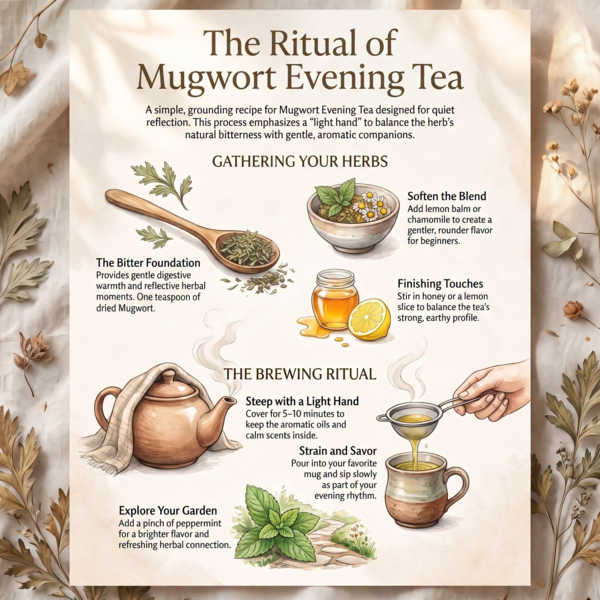
Traditional practice emphasizes starting Mugwort dreamwork gradually, allowing your system to acclimate to the herb’s influence. Begin with a simple practice: brew a light tea (1 teaspoon dried herb per 8 ounces water, steeped 5 to 7 minutes) about an hour before bed, focusing your intention on remembering your dreams. Keep a journal at your bedside and record whatever you recall immediately upon waking, before the images fade. After several nights with tea, you might add a dream pillow, a small muslin sachet filled with Mugwort, perhaps blended with Lavender for a gentler effect. Place it inside your pillowcase so the subtle aroma accompanies you through the night.
The practice of setting intention before sleep matters significantly when working with Mugwort. The herb does not create visions from nothing, it amplifies and clarifies the dreamwork your unconscious mind is already doing. Before sleep, spend a few minutes in meditation, asking a question you would like insight on, or simply stating your intention to remember and learn from your dreams. This conscious engagement with the dream process, combined with Mugwort’s physiological effects, creates optimal conditions for meaningful dreamwork.
MUGWORT AND THE MOON: LUNAR ALIGNMENT IN SPIRITUAL PRACTICE
The etymological connection between Mugwort and Artemis, Greek goddess of the moon, wilderness, and liminal spaces, hints at an ancient recognition of the plant’s lunar correspondence. Modern practitioners working with Mugwort often find their practice naturally aligning with moon phases, particularly the full and new moons when lunar influence on earth energies is considered to reach its peak. This is not mere romantic association; traditional herbalism across cultures has long observed connections between certain plants and celestial cycles, with the lunar month offering a practical framework for cyclical spiritual work.
Full moon work with Mugwort tends toward amplification, using the moon’s illuminating energy to bring unconscious material into awareness, heighten intuition, and charge ritual tools or preparations. A simple full moon practice involves creating Mugwort moon water: fill a clear glass jar with spring water, add a tablespoon of dried Mugwort, seal it, and leave it in direct moonlight overnight. In the morning, strain out the plant material. This lunar-charged water can be used to cleanse ritual objects, added to baths for ceremonial purification, or sprinkled around your sacred space to invoke Mugwort’s protective and vision-enhancing properties.
New moon Mugwort work emphasizes intention-setting, clearing, and preparing for new cycles. This is an ideal time to create fresh dream pillows, craft new smoke bundles, or begin a dedicated dreamwork practice. The dark moon phase supports introspection and inner journey work, exactly what Mugwort facilitates. A new moon ritual might involve cleansing your space with Mugwort smoke while consciously releasing what no longer serves you, then drinking Mugwort tea while journaling about intentions for the coming lunar cycle.
Regular monthly practice with Mugwort following moon phases helps develop sensitivity to both the herb’s effects and your own cyclical patterns of intuition, energy, and receptivity. Keep notes in your dream journal about how your experiences with Mugwort shift across the lunar month. Many practitioners find their dream recall strongest around the full moon, while new moon work tends to yield more symbolic or archetypal dream content requiring interpretation.
Spletno mesto za boljše delovanje uporablja piškotke. Ti piškotki ne posegajo v vašo zasebnost. Z obiskom in uporabo strani soglašate z uporabo in beleženjem piškotkov.